Hair Transplant Recovery: The Real Timeline
 Written by Michael Seutin,
founder — former nurse, researching transplant pricing.
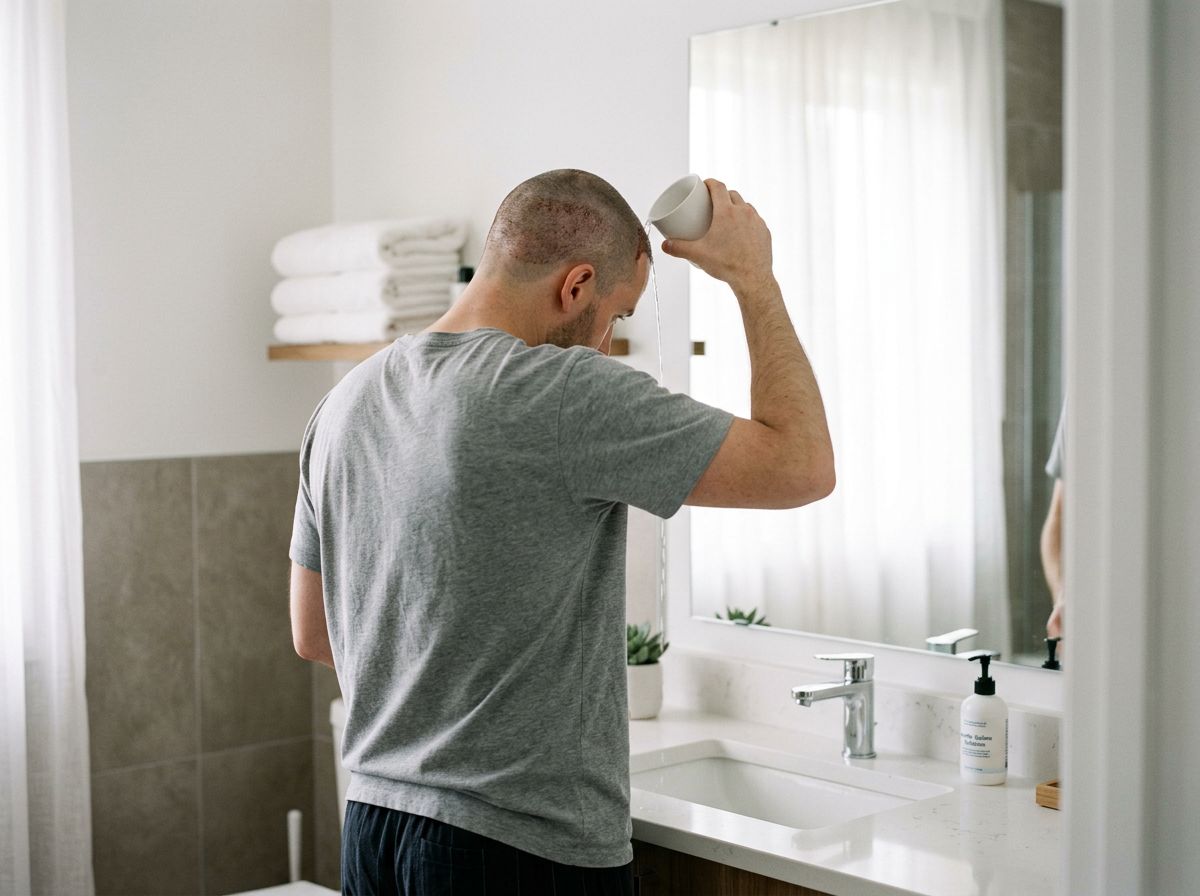
The surgery usually takes a day; the full result takes 10 to 18 months[1]. In between come scabs, shedding, and a dormant phase of 10 to 14 weeks before the new hairs start to grow[6]. Here's what happens, week by week, the dates the sources actually support, and why the rest belong to your surgeon's written protocol.
Recovery, one question at a time
Milestones and aftercare
Day 7, 10, 14 and 21: scabs, washing, the start of the shed, and when the grafts are secure.
Why the forehead swells around day 3, how long it lasts, and what sleeping upright does and doesn't do.
When the crusts form and fall off, why first-wash dates disagree, and the scab that means call the clinic.
The first two weeks, the first month, and the question to settle before you pay: who handles aftercare once you're home.
There's no official no-fly rule for hair transplants. What the NHS and FCDO do say, and what to get in writing.
How the back of your head heals, why FUE is not scarless, and why overharvesting can't be undone.
One day in the clinic, roughly 4 to 10 hours of surgery, a year for the result, and who does which part.
Why the new hairs fall out in the first weeks, why some of your own hair can go too, and when regrowth usually starts.
Months 2 and 3: the dormant phase, the 'ugly duckling' stretch, the first new hairs, and why it's too early to judge.
The month the NHS says new hair usually starts to show: why it looks thin, and why it is still early.
Halfway through the first year: what one study counted at 6 and at 12 months, and why it's still too early to judge.
What a study found about when grafts stop coming loose, why scabs matter, and the hat question to settle before surgery.
Pain, risks and safety
Where the pain actually comes from, what the first days feel like, FUE against FUT, and the pain that isn't normal.
What to expect, what is rare, and why published complication rates run from almost none to nearly half.
How rare it is, how to tell it from harmless bumps, why some start weeks later, and who treats it once you're home.
What a botched result looks like, why it happens, what repair can and can't fix, and the questions that lower the odds.
Bumpy skin around the grafts: why depth and slit size cause it, how to tell it from cysts, and whether it settles.
Why there is no single success rate, what four studies found and in whom, why transplants fail, and when to judge.
What the FCDO, NHS and ISHRS say, what is and isn't known about deaths, and the checks that matter before you book.
Transplanted hair usually stays; the hair around it may not. What a 4-year study found, and why second transplants happen.
Why no transplant is scarless, how FUE dots differ from the FUT line, what widens a scar, and what can be done.
Week by week, month by month
| When | What happens | What you do |
|---|---|---|
| Day 0 how long it takes | Surgery, usually within the day[1]: 3 to 8 hours in the ISHRS patient brochure[6]. You leave with a light dressing or none at all[6]. | Don't touch the grafts[1]. Sleep the way your clinic says, but don't count on the pillow: one 340-patient trial found sleeping position alone did not prevent swelling[8]. |
| Days 1–3 swelling | Swelling, if it comes, usually appears around day 3, forehead first, then the eyelids[7]. The donor area feels tight for 1 to 2 days, and small crusts form on each graft[6]. | First wash when your protocol says: published dates run from day 2 or 3[9] to day 6[1]. Not on your side or face down[7]. Fly only once your surgeon clears you, in writing (what to check). |
| Days 4–9 scabs and washing | The crusts flake off by 5 to 14 days[6]. | Wash exactly as your protocol says. Don't pick: accidental knocks to the scalp can push grafts out[3]. |
| Day 10–14 10 days after | Scabs are usually gone by 1 to 2 weeks[5], and FUT stitches come out at 10 to 14 days[1]. Day 14 ends the 2 weeks in which the NHS says the grafts are not secure[1] (the donor area). | Work: the ISHRS minimum is one week after FUE, two after FUT[10]. Hats and normal washing: when your protocol says. |
| Weeks 2–6 shock loss | Shock loss: the transplanted hairs shed[1], usually within 3 to 4 weeks[7], while the roots remain[6]. Most patients who still have native hair in the zone shed some of it too[3], and that is typically temporary[2]. | Nothing; it is expected. Exercise: the NHS says you may be told to cut down for the first month to reduce scarring[1]. The return date is your surgeon's. |
| Months 2–3 3 months after | The dormant phase: the roots rest for 10 to 14 weeks before the new hairs grow[6]. | Wait. |
| Months 4–6 4 months after 6 months after | New hair usually starts to appear around month 4[1]. | Hair grows about 1 cm a month[5], so early photos understate the result. |
| Months 7–9 | Still growing: the full result often takes a year or more[5]. | No primary source we read puts a reliable density percentage on these months, so we don't either. |
| Months 10–18 | The full result should be seen after 10 to 18 months[1]. | Judge the outcome, and the clinic, once that window has passed. |
The Turkey schedule
This timeline is why Istanbul packages are built around a short stay: surgery, a wash and check at the clinic, then the flight home. When you can fly is your surgeon's call, not the package's: the FCDO's advice for planned surgery abroad is to check when you can fly home before you travel, because air travel after major surgery increases the risk of a blood clot[4]. Our flying-home guide covers what to get in writing. Once you are home, the clinic is in another country, and the NHS warns that overseas clinics may not provide follow-up treatment, or not to the same standard[11]. So before booking, ask two questions: who reviews your healing photos (a medical team or a sales rep?), and what the written aftercare protocol says week by week. A clinic without a written protocol is improvising with your grafts.
Return-to-life dates: whose protocol?
Most of the gym, sauna and haircut dates traded online have no primary source behind them. The ISHRS says return to exercise, water exposure and similar rules vary among surgeons, and to follow your own surgeon's instructions rather than any website[5]. What the sources do say:
- Work: the ISHRS minimum is one week after FUE and two weeks after FUT, and if the recipient area isn't shaved you might be back sooner[10]. The NHS says you may need 1 to 2 weeks off[1].
- Exercise: the NHS says you may be told to cut down in the first month to reduce scarring[1]. The date you restart is your surgeon's.
- Hats and helmets: a 2008 review says to avoid helmets for the first three weeks[9]. For hats, follow your protocol (what the evidence says about hats).
- Sun and water: after cosmetic surgery abroad the NHS says not to lie in the sun or go in the water straight afterwards[11], and a 2018 review lists excessive sun damage to the scalp among the factors behind poorer growth[3].
- Haircuts and dye: no primary source we read gives a date. The ISHRS says to check with your surgeon before using a dye, and to use no styling products until healing is complete[13].
Normal vs call-the-clinic
Normal: forehead swelling, especially 2 to 6 days after surgery[8]; itching as the skin dries and crusts[3]; numbness, which usually goes within 2 to 8 months[6]; pimple-like bumps (sterile folliculitis), the most common problem in one surgeon's series of 2,896 patients[7]; and the shock-loss shed itself[1]. Contact the clinic: the NHS says to do it as soon as possible about severe pain or any unexpected symptoms[1]. Swelling with pain and redness, with or without fever, should be taken seriously[7], and pus-filled bumps or a red, tender, soft area in the grafts or along the incision can mean infection[3]. This is exactly what the aftercare-protocol question above is for.
The part nobody budgets for: month 3
The NHS's window of extra care is the first 2 weeks[1]. The harder stretch is the dormant phase: you've paid, healed and shed, and the new hairs won't begin to grow for 10 to 14 weeks[6]. Knowing the curve in advance is the fix: new hair usually appears after about 4 months[1], and before/after photos taken at 12 months or later, not day-10 buzzcuts, are how you set expectations. Don't pick a technique for a faster timeline: the ISHRS says DHI is not a hair transplant method and should not be marketed as such[12]. What unshaven work changes is visibility: if the recipient area isn't shaved, the ISHRS says you might be back at work sooner[10].
Still planning? The graft calculator estimates your graft count, how we rank covers what to verify before trusting a clinic with the aftercare that follows, and the complete Turkey guide walks the whole journey end to end.
Sources
Primary sources only: the NHS, the FCDO, the ISHRS and peer-reviewed papers on PubMed and PubMed Central. Each was opened and read on the date shown.
- Hair transplant — NHS. Read 2026-10-22.
- FUT Hair Transplant: Benefits, Procedure & Recovery — ISHRS. Read 2026-10-22.
- Complications in Hair Transplantation (Kerure & Patwardhan, J Cutan Aesthet Surg, 2018) — PubMed Central. Read 2026-10-22.
- In hospital abroad: going abroad for medical treatment and planned elective surgery — FCDO (GOV.UK). Read 2026-10-22.
- FUE Hair Transplant: Benefits, Process & Recovery — ISHRS. Read 2026-10-22.
- Medical and Surgical Options to Restore and Maintain Scalp Hair (patient brochure, 2005) — ISHRS. Read 2026-10-22.
- Complications of Hair Transplant Procedures: Causes and Management (Garg & Garg, Indian J Plast Surg, 2021) — PubMed Central. Read 2026-10-22.
- Hair Transplantation: Preventing Post-operative Oedema (Gholamali et al., J Cutan Aesthet Surg, 2010) — PubMed Central. Read 2026-10-22.
- Hair transplantation surgery (Khanna, Indian J Plast Surg, 2008) — PubMed Central. Read 2026-10-22.
- Top 5 Things to Know About Hair Transplantation — ISHRS. Read 2026-10-22.
- Cosmetic surgery abroad — NHS. Read 2026-10-22.
- A Guide to Hair Transplant Surgery — ISHRS. Read 2026-10-22.
- Hair Grooming & Styling After Hair Restoration Surgery — ISHRS. Read 2026-10-22.
Clinics that publish what their package includes
These clinics state on their own website what their package price includes. In their words, as recorded in our directory. To check what your own quote says about aftercare, use the quote check.
AHD Clinic
Antalya, Turkey · Dr. Hakan Doğanay
Antalya clinic led by Dr. Hakan Doğanay. Publishes team packages priced by graft ceiling, from €3,300 for up to 2,500 grafts to €5,200 for up to 4,500 grafts, under Dr. Doğanay's supervision. It also publishes €3 per graft for an operation Dr. Doğanay performs himself. Both options include medicines, accommodation and airport pickup.
Checked against the clinic's own site, October 2026.
Hairneva Clinic
Istanbul, Turkey · Assoc. Prof. Dr. Güncel Öztürk
Istanbul clinic in Beşiktaş led by Assoc. Prof. Dr. Güncel Öztürk, a European Board certified plastic surgeon (FEBOPRAS). FUE and DHI. Publishes a typical package range of $3,000–$6,000, which it says covers surgery, a two-night hotel stay, transfers, medication and twelve months of online follow-up. It prices packages, not grafts, and publishes no per-graft rate.
Checked against the clinic's own site, October 2026.
Compare quotes before you commit
Tell us roughly what you need. Michael reads every enquiry personally and replies with what our data shows on price, who operates, and what to ask before you pay a deposit. We don't forward your details to any clinic — no sales calls, no lead brokering.
Get told when a clinic's price or surgeon changes
We re-check every clinic we list against its own website. When one starts publishing a price, stops naming its surgeon, or changes what it charges, you hear about it. No recommendations, no sales calls, and we don't sell or share your address. Nothing is being sent yet — this is the list for when it is.
One-click unsubscribe in every email. Privacy Policy.
Recovery questions, answered
When your surgeon clears you, in writing. No official guidance sets a hair-transplant-specific wait: the NHS no-fly advice for cosmetic surgery abroad lists other procedures, not this one. The FCDO advises checking when you can fly home before you travel, because air travel after major surgery increases the risk of a blood clot. The NHS says the grafts are not secure for the first 2 weeks, so keep bags and headrests off the grafted area in transit.
Not before two weeks, on the NHS's account: it says to be very careful with the transplanted hair for the first 2 weeks because the grafts will not be secure. When you can wash normally or wear a hat is set by your clinic's written protocol, so follow it rather than a general timeline.
That's shock loss, and it's expected. The NHS says the transplanted hair will often fall out after a few weeks and later start to grow back, and the ISHRS says shock loss can occur in almost any patient and is typically temporary. A 2018 review says shedding of your existing hair in the transplant zone typically begins 2 to 6 weeks after surgery and is seen to some degree in most patients who still have hair there.
When your surgeon's written protocol says. The NHS says you may be told to cut down on exercise in the first month to reduce scarring, and the ISHRS says return-to-exercise and water-exposure rules vary among surgeons, so follow your own surgeon's instructions. No primary source we read gives a single date for the gym, pools or sauna.
The NHS says new hair usually starts to appear after about 4 months and the full result should be seen after 10 to 18 months. The ISHRS notes that hair grows about 1 cm a month, which is why the full result often takes a year or more. Judge the outcome, and the clinic, once that window has passed.